Feedback
Professional tasting notes turned into 16 wine sheets that help every visitor understand what sets one cuvée apart from another.
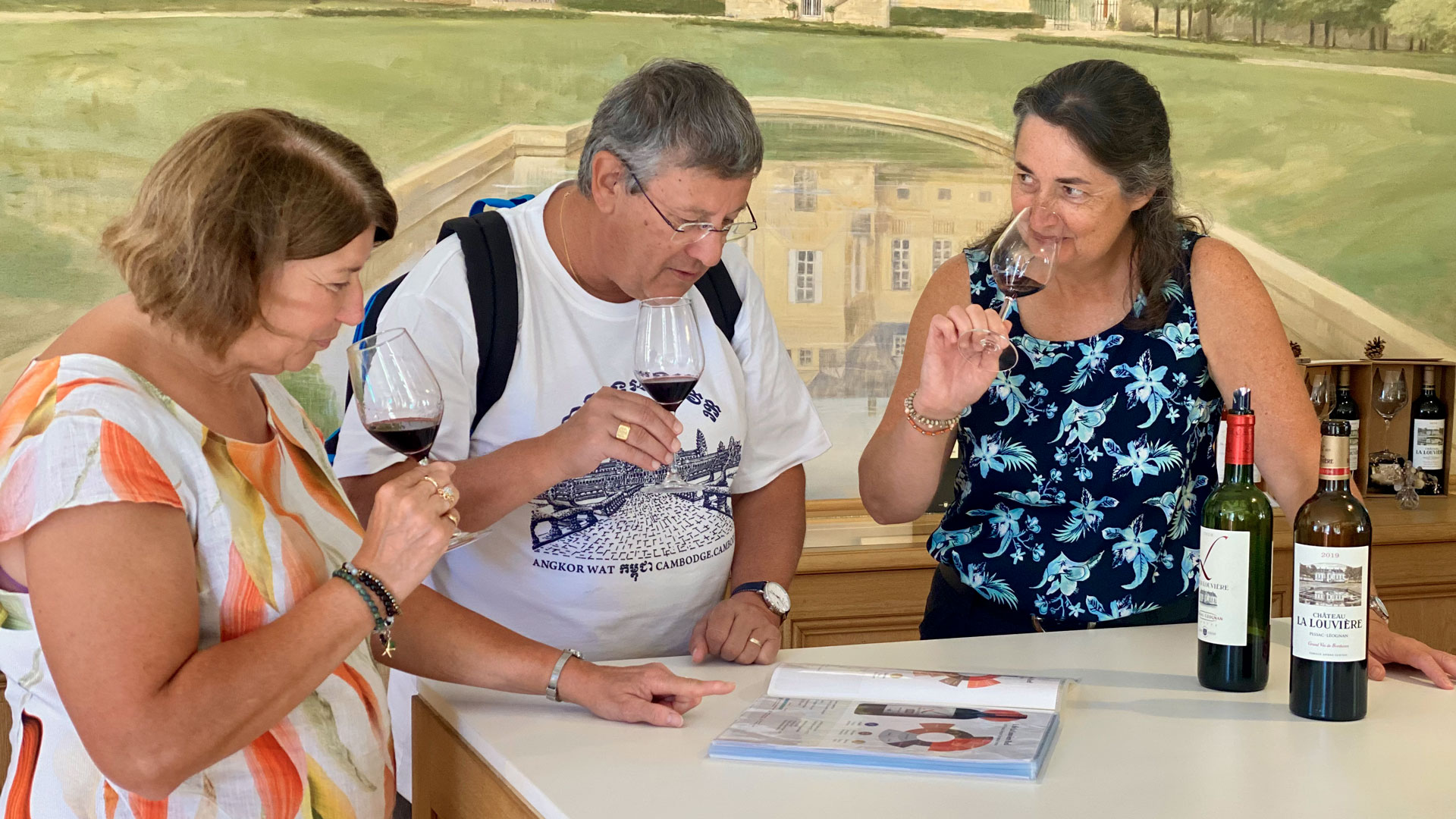
At Château La Louvière, visitors discover a wide range of wines, each with its own character, and it is not always easy to understand what sets one cuvée apart from another. To help them find their way, the estate turned to Tastee to characterise the profile of each cuvée from professional tasting notes. The result is a set of 16 clear, visual wine sheets, in French and English, used with visitors during tastings at the château's shop.
An emblematic estate of the Pessac-Léognan appellation, acquired by André Lurton in 1965, Château La Louvière welcomes visitors all year round, whether they come to tour the estate, taste its wines or buy wine at the shop. The range of Vignobles André Lurton, which today brings together six properties in the Bordeaux region, includes many cuvées with distinct styles. For visitors, telling them apart is far from obvious. The challenge was to give them a faithful picture of each wine's style and help them find their way through the range.
The château teamed up with Winespace to characterise the organoleptic profile of each cuvée, independently of vintage, and to make this information available to visitors in a visual, engaging and accessible way.
For each cuvée, Winespace first selected from its database a series of tasting notes considered representative of its style. All were written by professionals, on vintages tasted during their ideal drinking window. This choice is essential. A wine tasted too young or too late says little about its true personality, whereas a wine tasted at the right moment reveals what defines it.
The aim is not to describe a particular vintage but to look beyond it. By cross-referencing several vintages, the analysis brings out the overall typicity of the cuvée, what remains constant from one year to the next and what visitors will find whichever vintage is served.
These notes were then analysed with Tastee. The platform identifies the aromas mentioned, groups them into families and assesses their importance in the wine's profile. It also measures the wine's main taste characteristics, such as structure, acidity and tannins. Everything is compiled into a single summary per cuvée, which forms the basis of the sheet. In total, 16 cuvées from the Vignobles André Lurton range were processed this way, each with its own sheet in French and English.
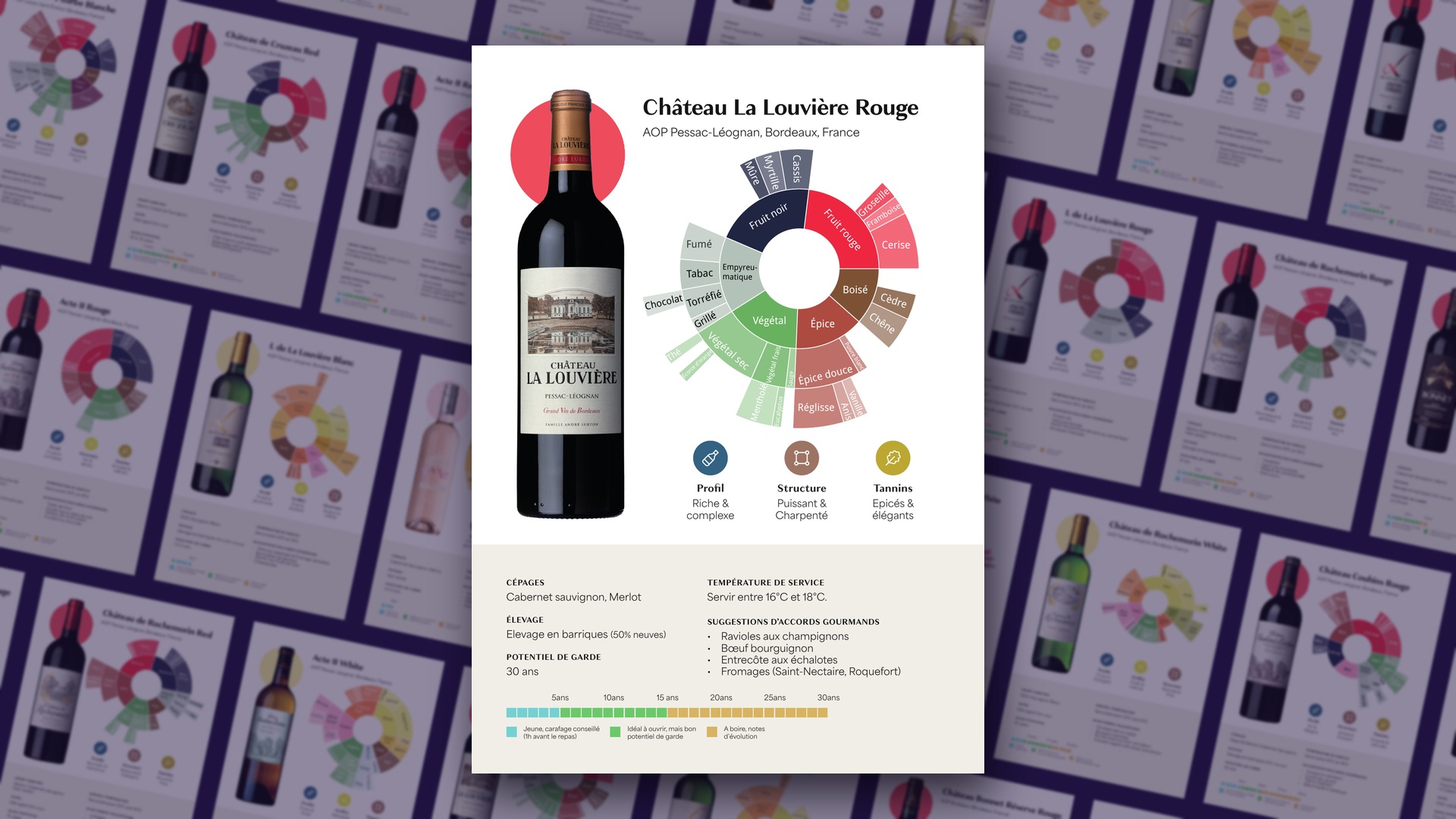
The next step was to decide what form this summary would take and which information to highlight. The choice fell on a one-page sheet per cuvée, organised to be read in a few seconds, from the most visual to the most practical.
The aroma wheel. At the centre of the sheet, it shows the wine's main aromatic families, then the detail of the most frequently cited aromas, such as cherry, blackcurrant or liquorice for Château La Louvière red. The size of each segment reflects the aroma's place in the wine's profile. Visitors can immediately see what they are about to smell and taste.
Three indicators. Below the wheel, three icons sum up the wine's character in a few words. For the red, they describe the profile, the structure and the tannins, “rich and complex”, “powerful and structured”, “spicy and elegant”. For the whites, acidity replaces tannins. It is a simple way to put words to a sensation, even without technical vocabulary.
Grape varieties and ageing. These technical markers answer the questions of the most curious wine lovers without weighing down the read.
Serving temperature and food pairings. Two very practical pieces of information that help visitors serve the wine properly at home and imagine which dish to open it with, from beef bourguignon for the red to sole meunière for the white.
The ageing potential timeline. It divides the wine's life into three phases, from youth, when decanting is recommended, to the ideal time to open it, then to the stage of evolved notes. At a glance, visitors know whether the bottle they are buying is ready to drink or will benefit from time in the cellar.
During a tasting at the château's shop, wine tourists see at a glance what they are about to taste. They can then compare their own perceptions with the aroma wheel. Finding in the glass the cherry or liquorice announced on the sheet is rewarding, and turns the tasting into a small treasure hunt in which visitors become active participants in their discovery.
The sheet also frees up the reception staff during busy periods, when the team cannot be with every group at once. Visitors then have all the keys they need to discover the wines on their own.
At the shop, it directly supports the buying decision. The timeline shows whether the wine is ready to drink or will benefit from waiting, and the suggested pairings help visitors picture it with a meal.
Available in French and English, it speaks to French visitors and wine lovers from abroad alike, without the team having to translate each wine's profile themselves.
In every case, the sheet draws its credibility from its origin. Its content does not come from generic marketing copy but from real tastings. What the sheet says is what the tasters actually perceived.
Building a sheet for each cuvée by hand, with the same rigour and the same level of finish every time, takes time, and this work comes round again with every new vintage. By starting from an automated analysis of tasting notes with Tastee, the estate saves this writing and design time without sacrificing any precision. The profile remains faithful to what the tasters perceived.
These sheets also become an asset that can be reused from one season to the next. Because they describe the typicity of each cuvée rather than a specific vintage, they remain valid whichever vintage is offered for tasting.
Château La Louvière's approach can benefit any property open to wine tourism. Many already have tasting notes, often in large numbers, but reserved for professionals. Turning them into material everyone can read becomes a real lever for hospitality and communication, just like the château's architecture or the quality of the tour. With Tastee, this work is based on real tastings and can be repeated for every cuvée, every vintage and every property.
Find out more about Vignobles André Lurton.
We turn your tasting notes into clear materials for your tasting room and shop.
Let's talk about your estate