One calibrated score, rather than a sum of sub-scores that everyone ends up adjusting.
Tastee is professional tasting software. And yet you will not find the OIV score sheet anywhere in it. That is not an oversight, it is a decision. Behind its apparent rigour, the sheet produces data that looks detailed but is hard to actually use.
In the nineties, international competitions multiplied and each one scored wines its own way. The International Organisation of Vine and Wine adopted a common standard to harmonise practices. That standard covers how competitions are run, including sample anonymity, jury composition and serving conditions, and it imposes a shared 100-point tasting sheet.
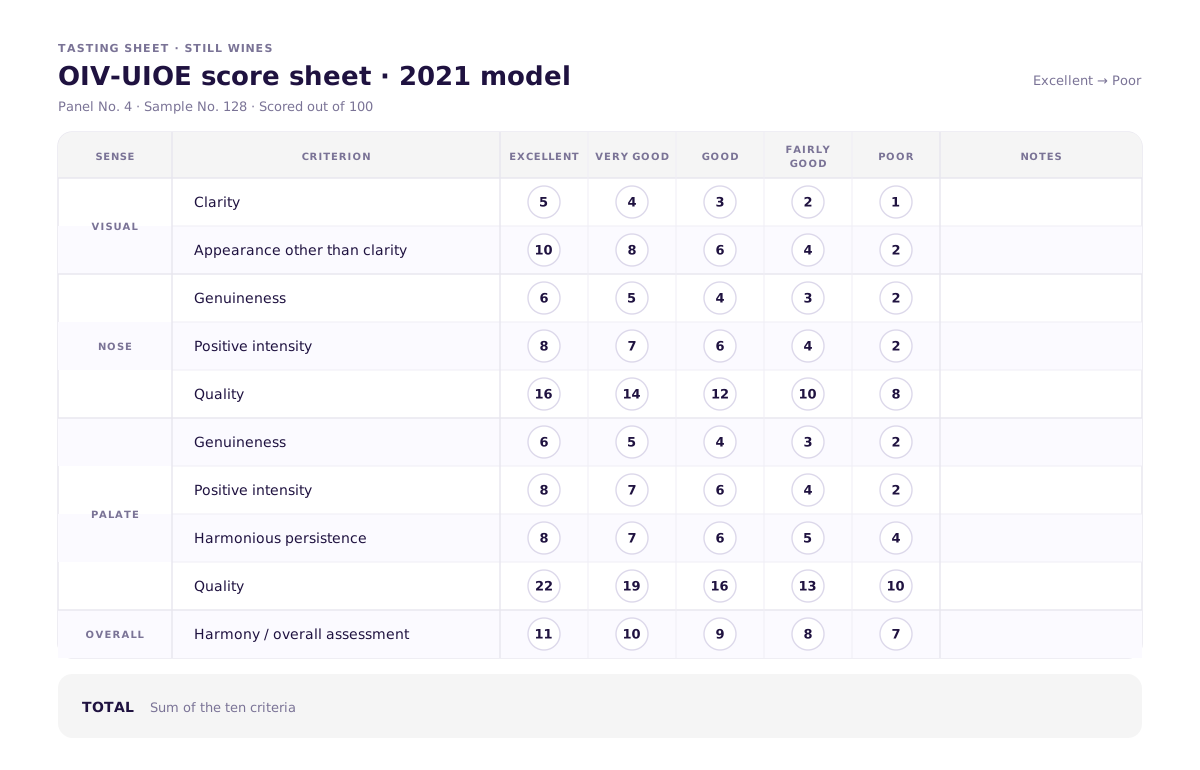
For still wines, it breaks judgement down into ten criteria spread across appearance, nose, palate and overall impression. The principle is sound: force the taster to structure their judgement. The trouble starts when you add it all up.
Each criterion is ticked on five levels, but they do not all carry the same weight. Clarity runs from 5 down to 1: one step is worth one point. Appearance runs from 10 down to 2: one step is worth two points. Quality on the palate runs from 22 down to 10: one step is worth three points.
In other words, moving a single box does not have the same consequence depending on the criterion. A taster can fill in the sheet carefully, criterion by criterion, and still end up with a total that does not quite match the overall judgement they have of the wine.
That mechanic becomes decisive once you compare it with the OIV award thresholds. Bronze starts at 80 points, silver at 82, gold at 85 and great gold at 92. Between silver and gold there are only three points.
And on quality on the palate, a single change of level moves the score by exactly three points. One box can therefore represent the entire gap between a silver medal and a gold medal.
Add to this that the sheet is presented out of 100, but does not go down to zero. Ticking the lowest level on every criterion still gives 40 points. The scale actually in use runs from 40 to 100, and every medal is decided between 80 and 100.
In that band, a three-point step is no longer a fine adjustment. A variation that looks minor on a theoretical 100-point scale becomes considerable on the scale actually used to hand out awards.
Two tasters can therefore hold a very similar view of the same wine and end up with noticeably different results, simply because they did not place their judgement on the same criteria. The final gap does not necessarily reflect a disagreement about the wine. It can simply reflect the mechanics of the sheet.
This is where a very common reflex appears. The taster finishes the sheet, looks at the total, then goes back. They change a criterion, not because their view of the nose or the palate has changed, but because the total does not match the overall judgement they had in mind.
That behaviour is perfectly logical. When a single step can win or lose three points, and three points separate silver from gold, the taster is naturally tempted to look at the overall result before validating their sub-scores.
The problem is that from that moment on, those sub-scores no longer describe only the wine. They also serve to adjust the final score. The same data then fulfils two functions: describing the wine and building the score. That is precisely what makes it hard to use afterwards.
The taster has spent time filling in several criteria. The organiser gets back data that looks very detailed. But what can they actually do with it?
Comparing two wines criterion by criterion becomes tricky if some sub-scores were adjusted to reach a total. Analysing an appellation, a vintage or a typicity is just as difficult. And in many competitions those sub-scores will never be used anyway: only the final score out of 100 will serve for the ranking and the awards.
So juries are asked to produce complex data whose analytical value remains limited.
On Tastee, the taster directly gives the score they have in mind, out of 20 or out of 100. No total to work back to, no going back and forth between criteria to reach the right sum.
The score is framed by a calibration scale in which every level is clearly described. Alignment between judges therefore comes from a shared definition of what each quality level means, not from adding up sub-scores. The taster builds their judgement, then puts down their score.
Dropping the OIV sheet does not mean dropping sensory analysis. Quite the opposite. On Tastee, the score does one thing: evaluate the wine. The tasting comment does another: describe it.
The taster writes their comment freely, in their own language. Tastee can then analyse all the jury's comments to extract a sensory profile: dominant aromas, structure, palate profile, qualities noted and points to watch.
Two functions that used to be mixed together are separated. The score serves the ranking. The comment serves understanding of the wine. And each of those becomes easier to use.
For the taster, scoring is faster and more natural. The comment helps structure judgement without forcing an artificial split of points across several boxes.
For the organiser, the final score remains directly usable for ranking the competition. And for the producer, the result is no longer limited to a score or a medal: they can also get a genuinely readable sensory summary.
Some competitions have to keep the OIV sheet to comply with their rules or their official recognition. That constraint is legitimate.
In that case, the question is not whether to drop the sheet, but what you actually expect from the data it produces. If the goal is only to justify a score, the sheet can become expensive in time for a limited benefit. If the goal is also to produce usable sensory data on the wines, the two uses probably need to be separated.
That is the choice we made with Tastee: a score to evaluate, a sensory analysis to understand. Trying to do both with the same boxes usually weakens both.
Tell us the number of samples, the number of tasters and the date. We come back to you within 48 working hours with a costed quote.
Request a quote